Week 1 Ideation
My capstone extends my ongoing practice in projection mapping, spatial audio, and sensor-driven generative systems into Haven Gallery's 360-degree cinema dome — a canvas I haven't yet worked in. The project synthesises the three "Cycles of 12" frameworks underpinning my theoretical practice — the colour wheel, Hero's Journey, and circle of fifths — into a cohesive production pipeline, drawing on the deep human significance of the number twelve, from the zodiac to ancient calendrical and musical systems, as a structuring logic across cultures. A twelve-stage narrative arc drives the piece: each section corresponds to a hue on the colour wheel, a key on the circle of fifths, and a stage in the Hero's Journey, combining visuals and spatial audio that shift together as the work progresses through its cycle. The result is a narrative, dome-native artwork demonstrating that these three cyclical structures share an underlying logic.
Project Description
Producing a 360 film with 5.1 surround sound that explores the relationship and synthesis of 3 artist tools based on cyclical divisions of 12. How these tools combine to create an artwork with deep meaning, that is greater than the sum of it’s parts. Rather than focusing on a script, the visuals are abstract, using visual fx and double-exposure techniques: the colour grading and music evokes the emotional journey of the piece.
Working title: Dodecahydra - ‘a mythical 12-headed beast’
From Greek - ‘Dodeca’ meaning 12, ‘Hydra’ meaning mythical multi-headed beast
Week 2
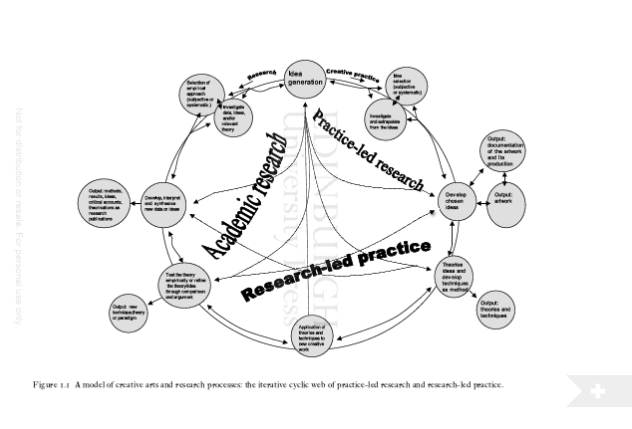
Iterative cyclic Web of Practice-led Research and Research-led Practice (Smith, H. et al., 2009)
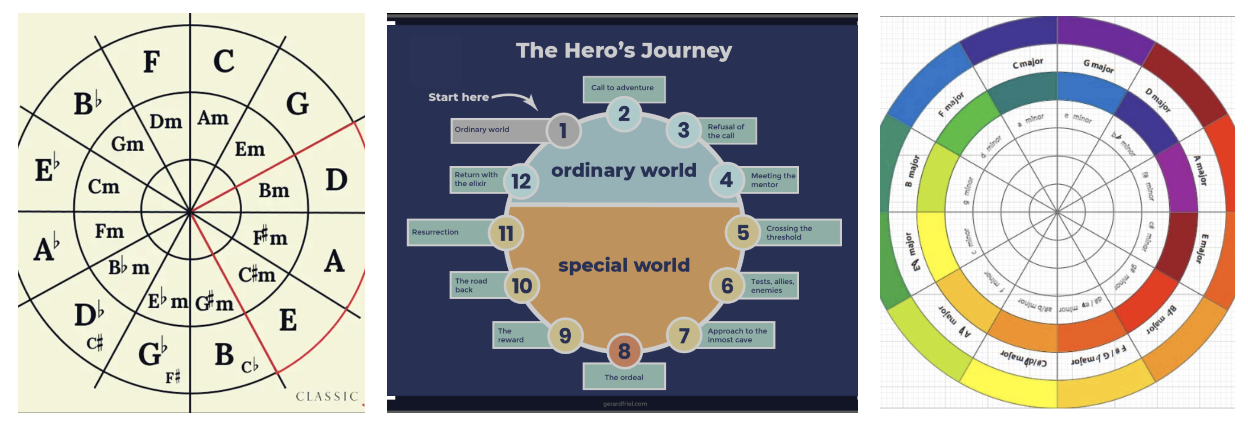
Circle of Fifths, Hero’s Journey, Jack Ox’s Colour Wheel
My methodology - Practice-based Research - the artefact is the research
Practice-based research (Candy, L., 2006): the creative artefact is the basis of the contribution to knowledge. You can’t fully understand the research without direct reference to the work itself. The written text contextualises the artefact but can’t replace it. My workflow produces a method, which is practice-led in Candy’s terms. My project is mainly practice-based, with a practice-led strand about the production workflow.
Daragh Henchy’s Apples and Oranges
https://creo.sae.edu.au/postgraduate/23/ Apples and Oranges
Daragh uses Deleuze’s categories to design individual scenes, much as I use the 12-stage wheel to design each section. He explicitly calls the framework “non-prescriptive”. That’s a ready answer to the critique that the Hero’s Journey is formulaic.
He concluded that his story-beat structure dragged the work toward action and spectacle (car chases, betrayals) and away from the philosophical experience he was aiming for. Twelve Hero’s Journey stages could exert the same pull. Abstract visuals are a great way to avoi that.
He tested nothing on an audience and like Kailan, he relied on autoethnography, needed no ethics approval, and listed audience studies as future work. Together they’re two SAE precedents for basing evidence on reflection.
His reflection led him to swap a planned screenplay for an “augmented treatment” with images, music and production notes. That pivot is documented as a finding, not a failure, which is reassuring for a three-trimester part-time project.
Paula Cordeiro
https://creo.sae.edu.au/postgraduate/60/ Building a Virtual Gallery: How the user journey can inform technological innovation towards best practice in creating A virtual gallery?
Her work is the closest local overlap to mine so far. She works with Byron’s artists, Council and regional gallery identity, all of which matter to Haven and to my previous work on funding and partnerships. Her Council-backed community business model sits right beside Haven’s for-profit eligibility-gap finding.
The audience journey as a design tool: her main method is mapping each step of a visitor’s experience: arrival, orientation, touchpoints and feelings. It transfers directly to my Haven exhibition in June 2027. How do people enter the dome, get oriented and move through the twelve stages, all “without verbal explanation”? A journey map could become a design document in my exegesis. Her finding that less tech-confident visitors needed a human guide is a familiar theme from some of Haven’s customers.
She uses Benjamin (1969) to discuss what digitised artworks lose. My project goes the other way: a correspondence system made physical, live and shared in one room. That’s an argument that the dome restores aura. It fits the question about what happens once these systems are “physically built and experienced”.
She cites Candy (2019), The Creative Reflective Practitioner. Two important notes are: Reflection-in-action: thinking while you make, adjusting in the moment. Reflection-on-action: stepping back afterwards to evaluate what happened and why.
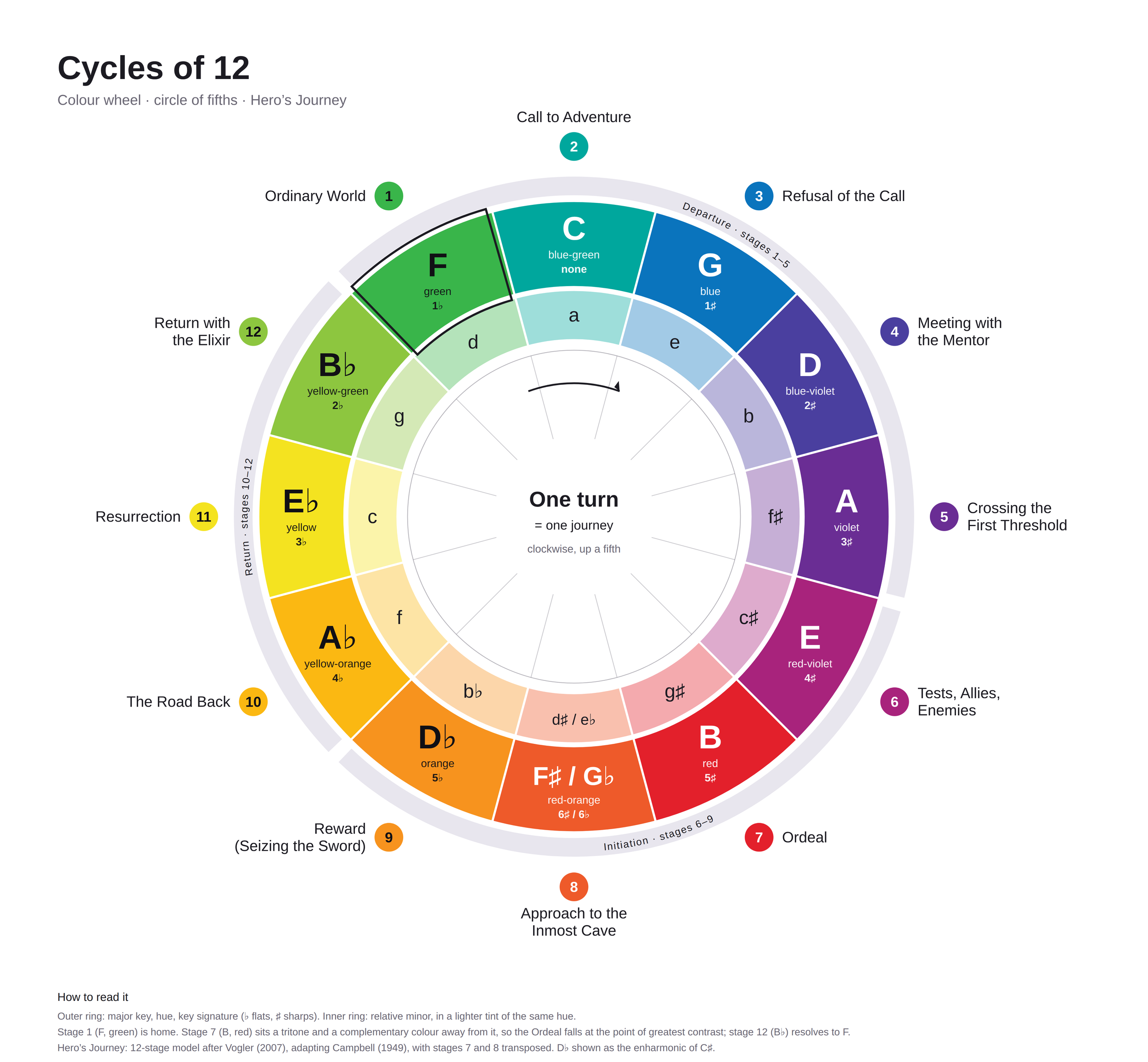
by Chris Daly, created 21 September 2026
Week 3 Annotated Bibliography
Batty, C. (2010). ‘The physical and emotional threads of the archetypal hero's journey: Proposing common terminology and re-examining the narrative model’ (Version 1). RMIT University. https://hdl.handle.net/10779/rmit.27444132.v1
The hero is the personification of a culture’s ideals, as embodied in its mythology.
Campbell, J., & Blake, E. (1990). ‘The hero's journey’. New York: Harper and Row.
This paper examines how this narrative tool can be used to affect an audience’s emotional and physical development within a story world.
Hartley, J. (2011). ‘Communication, Cultural and Media Studies: The Key Concepts’. Taylor & Francis Group. https://ebookcentral.proquest.com/lib/sae/reader.action?docID=710094&ppg=220
A book containing useful information about PostModernism
Horsburgh, Andrew J. (2015) ‘An Interactive Multimedia Experience: A Case Study’. Southampton Solent University, Paper 9342 https://aes2.org/publications/elibrary-page/?id=17766
A paper outlining the potential for commercialisation of home cinemas from a 2D screen with optional surround sound to 3D audio and visual immersive home entertainment systems
Ox, J. (2007, January). ‘Colour Harmony Wheel based on the Circle of Fifths’. researchgate.net. https://www.researchgate.net/publication/221629521_Visualization_and_the_art_of_metaphor
A paper outlining a method of matching colours to harmonic intervals based on the circle of fifths
Ox, J. (2016) ‘Color Systems are Categories that Carry Meaning in Visualizations: A Conceptual Metaphor Theory Approach’ Proc. IS&T Int’l. Symp. on Electronic Imaging: Human Vision and Electronic Imaging, https://doi.org/10.2352/ISSN.2470-1173.2016.16.HVEI-141
Expanding on ideas of what meanings different colours carry and how to categorise them.
Week 4 Research Question
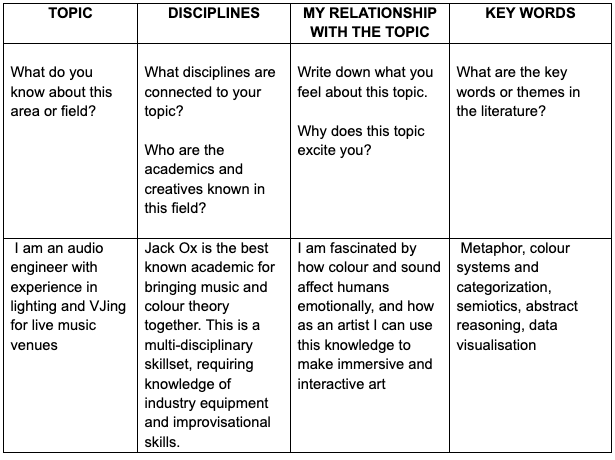
Draft Research Questions:
How can a VJ bridge the structural symmetries of the Circle of Fifths and the colour wheel with narrative theory to improvisational, abstract live visuals?
How can a twelve-stage correspondence of hue, musical key and narrative stage be structured in a 360° dome so audiences sense narrative progression without verbal explanation?
What production workflow lets spatial audio and real-time graphics shift together across a twelve-stage arc in a dome?
What happens to the “universal” claims of correspondence systems once they are physically built and experienced in an immersive space?
The Dodecahydra graphical tool is currently a first iteration synthesis that came before the research question. Andersson (2012) accepts that an answer can work as a question, and any of the three elements (question, method, answer) can be the entry point, provided the method is thorough and relevant to others. The graphical tool came first; the research asks what it does in the dome.
Week 5
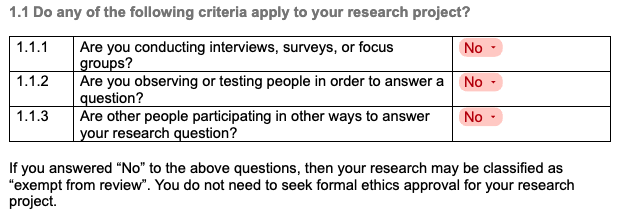
Risk Assessment Checklist
Minimal risk for my project pitch Dodecahydra
https://docs.google.com/document/d/1rPktbkuCMOt6ho9_WX_xSGdeOWWtmoF0pwmracXesuw/edit?usp=sharing
Theoretical / epistemological reflexivity (Foley, D.E., 2002)
As Haven’s Operations Manager and also an artist making work in its dome, an insider position shapes my access, resources and judgement. It also connects to findings I already have, such as Haven’s for-profit status and the funding gap. Foley’s main criticism of autoethnographers is that they explore feelings but rarely the structural conditions of their work. My research lets me avoid that weakness.
Abduction: This means tacking back and forth between practice and theory, which is essentially what practice-based research is. My decision to swap the Ordeal to stage 7 so it lines up with B and red is a textbook abductive moment: the artwork pushed back on the theory, and I changed the theory. Moments like that are my data.
Foley’s realism depends on making evidentiary claims, so I plan to keep a dated practice journal from this trimester. It will include:
A decision log, with the Ordeal swap as entry one
Versions of the wheel graphic
Screen captures and audio sketches from tests in the dome
Notes after conversations with supervisor Phil, colleagues Jeremy, Tony and the owner of Haven Gallery Simon
Grad Seminar Reflection 1 Kailan O’Dell
Building Toward a Timbral Tool-kit asks how the emotional associations of keyboard timbres can be used as composition tools. His research makes the same core move as my project pitches to do. Where his links a sound property to an emotion, I am linking each of my 12 segments to a hue, a key and a Hero’s Journey stage. Both are correspondence toolkits. The difference is that he tested his links, while mine come from inherited systems (colour wheel, circle of fifths). His method shows how I could test whether each stage actually feels as intended, e.g. whether stage 7 (Ordeal, B, red) reads as unease.
Interestingly, he mentions the 40 emotion words in the Geneva Emotional Music Scale (GEMS, Zentner et al. 2008). I could try run it on each of the 12 stages as a structured reflection tool. The three broad groups even suggest an arc shape: vitality and sublimity at departure and return, unease peaking around the Ordeal. One caution he raised: the scale’s authors argue sadness is more perceived in music than felt, which matters for the darker stages. He drew a clear line that in practice-based research the artwork is the contribution; in practice-led research the method is. He chose practice-led, and so far I’ve framed Dodecahydra as practice-based, so this is a useful prompt for me to think about how I execute my project and research. His main suggestion for further research was timbre that changes over time, which could tie into the way that my method harmonises a perfect fifth up to each consecutive stage, creating a 12-stage emotional arc. His work potentially frames the gap that I seek to explore.
His test pieces had contrasting A and B sections, which I don’t think is a method that will work for my project. When evaluating individual stages, each needs to hold one clear emotional identity for my synthesis of structures to work together.
I was intrigued by his idea of an audio “brightness” value. It gives me a measurable, defensible way to tie audio to colour in an abstract film like mine, rather than a purely symbolic one. In the Q&A, a panellist suggested turning this data into light shows, to which Kailan’s reply was that visuals should be tied directly to the sound itself, such as overtones and frequency analysis, not to charts of results. This is very much the world that I live in.
Similarly to my project, there is the audience question. He measured only his own responses, partly to avoid an ethics application, and the panel kept pushing “audience response as part two”. My dome artwork is an audience experience, and so far I’ve decided to stay with self-reflection like him rather than gather audience data, which would need ethics approval.
Grad Seminar Reflection 2 Reza Shams
Cycles of 12 are Lacan’s “Symbolic”. The colour wheel, the circle of fifths, the zodiac and the Hero’s Journey are inherited cultural codes. Reza’s point is that each viewer reads symbols through their own background, and the Real is whatever escapes the symbols. His example was translating Persian thoughts into English. This lines up with Kailan’s point about cultural associations. My audience may not read stage 7 as “B / red / Ordeal”, and Lacan supports a way to say that this is fine, because the encounter is the work rather than the decoding.
The dome changes the gaze. Reza treats Lacan’s gaze as a two-way exchange between the image and the viewer. A 360° dome has no frame and no single viewpoint the director controls. The viewer chooses where to look, which film theory hasn’t fully worked out for cinema domes.
Reza argued against classic, formula-driven screenwriting. He quoted Lacan: we can predict where a person’s right foot will land, but never the left, so no human can be reduced to one formula. Campbell’s monomyth is regularly criticised as universalising in exactly this way. One answer is that the 12 stages are a compositional scaffold for colour and sound, not a claim about how people are.
Reza’s indexical-versus-probabilistic distinction about how AI generated content is homogenised, like the “make it beautiful” output he showed. Rule-based generative systems like the shaders I design myself are very different from AI image models. Dodecahydra is a tightly authored symbolic system, tailored by many creative decisions similar to the methods I use as a VJ.
Reza is writing a book on human history as a history of disclosure, running from cave painting through mythology and religion to modernity. My interest in ancient twelve-fold systems, and a dome as a shared, enclosing space, fits that lineage well. Heidegger’s (1971) idea of the artwork as disclosure is a good framing for practice-based research where the artefact is the research.
References
Benjamin, W. (1969). The work of art in the age of mechanical reproduction. In H. Arendt (Ed.), Illuminations (H. Zohn, Trans., pp. 217–251). Schocken Books. (Original work published 1935)
Candy, L. (2006). Practice based research: A guide (CCS Report 2006-V1.0). Creativity and Cognition Studios, University of Technology Sydney. https://www.creativityandcognition.com/resources/PBR%20Guide-1.1-2006.pdf
Candy, L. (2019). The creative reflective practitioner: Research through making and practice. Routledge. https://doi.org/10.4324/9781315208060
Foley, D. E. (2002). Critical ethnography: The reflexive turn. International Journal of Qualitative Studies in Education, 15, 469–490.
ISSN: 09518398
Heidegger, M. (1971). The origin of the work of art. In Poetry, language, thought (A. Hofstadter, Trans., pp. 15–86). Harper & Row. (Original work published 1950)
Magnus Andersson. (2012, April 10). What is an artistic research question? https://www.magnusandersson.no/musik-forskning/what_is_artistic_research/
Smith, H., & Dean, R. T. (Eds.). (2009). Practice-led research, research-led practice in the creative arts. Edinburgh University Press.
Zentner, M., Grandjean, D., & Scherer, K. R. (2008). Emotions evoked by the sound of music: Characterization, classification, and measurement. Emotion, 8(4), 494–521. doi.org
